

RE Zale, ER Edelman. "Cardiorenal Hemodynamic Coupling: Mechanical Circulatory Support Augments Renal Blood Flow via Renal Vasodilation"
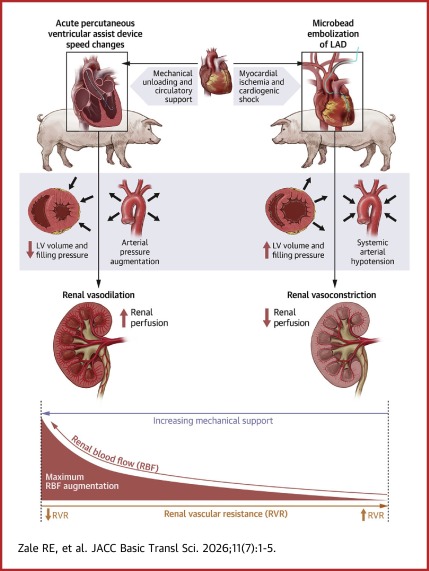
Summary: Robust cardiorenal hemodynamic coupling influences outcomes in cardiogenic shock (CS), with concomitant renal failure a persistent challenge despite the use of mechanical circulatory support (MCS). The authors investigated cardiorenal hemodynamic coupling during progressive left ventricular failure and percutaneous ventricular assist device (pVAD) unloading in a porcine model. Renal blood flow (RBF) and aortic, left ventricular, and central venous pressures were continuously measured across progressive CS and varying pVAD support. During CS progression, increased left ventricular end-diastolic pressure and reduced mean arterial pressure correlated with elevated renal vascular resistance (RVR) and decreased RBF. Increasing pVAD support reduced left ventricular end-diastolic pressure and increased mean arterial pressure in correlation with decreased RVR, demonstrating bidirectional cardiorenal coupling. RBF depended primarily on RVR across modeled physiological states, and elevated RVR limited the renal hemodynamic impact of pVAD support. These findings suggest that relative renal vascular tone strongly affects the effect of MCS on renal perfusion, which may have critical implications in CS management.
Highlights:
- Renal failure is a persistent challenge in CS despite advanced intervention including MCS.
- MCS can augment RBF by inducing renal vasodilation.
- The magnitude of RBF augmentation depends on relative RVR.
- Additional preclinical and clinical studies are needed to optimize use of MCS for renal support.