

 R Tzafriri, SA Parikh, ER Edelman. "Endovascular Drug Delivery from Stents and Balloons in Peripheral Arteries: What Every Interventionalist Must Know"
Synopsis: The effective and safe delivery of drugs to arterial targets via endovascular devices is governed by several key principles. These include the concepts of dissolution, diffusion and convection, drug binding (specific and non-specific), the presence of barriers to absorption, mechanically driven delivery, and finally, the interaction between the drug, delivery vehicle, and the accepting arterial wall. Though the understanding of stent-based drug delivery is vast, more work is needed to better define the drivers of balloon based delivery. Similarly, despite some similarities between the coronary and peripheral arteries, there are considerable differences that account for some of the failures of direct application of coronary technology into the peripheral vascular space. Future technological breakthroughs in peripheral vascular interventional techniques that build upon current drug delivery technologies will require investigators willing to acknowledge the similarities and differences between these different vascular territories, while developing technologies specifically adapted for peripheral arteries.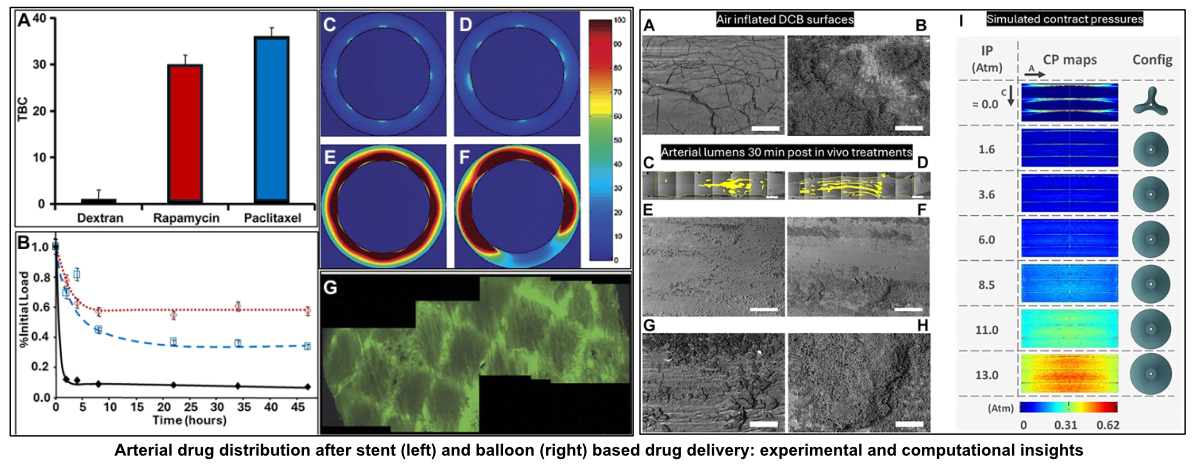
Key points:
- Despite being one contiguous system, there are drastic architectural, ultrastructural, and biophysiological differences between the coronary and peripheral vascular beds.
- The technologies that have been developed to perfect endovascular revascularization in the coronary artery defies a direct application in the peripheral artery arena.
- An understanding of drug delivery mechanisms and the barriers to absorption is imperative in the development and application of devices in the peripheral arteries.
- Current drug delivery devices available for above-knee targets are much broader than for below-knee targets; further studies are necessary to fully comprehend successful delivery in below-knee arteries.